
Narratology
Ryan, Marie-Laure
First published March 10th 2023, no current revisions
Narratology, the study of the properties of stories, provides game studies with a variety of concepts of transmedial applicability, but it must also deal with the specific nature of the narrative game situation: the productive role of the player, the computer's double function of implementing rules and visually displaying the player's actions, the relation between the narrative script written into the game's design and the story created by the player during game time, and more generally, the relation between gameplay and game story.
Introduction
Narratology, a term coined by Tzvetan Todorov in 1969, is a field of study concerned with the distinctive and optional properties of stories. The structuralist pioneers of the discipline, especially Roland Barthes and Claude Bremond, conceived storytelling as a phenomenon that can be instantiated in a variety of media beside language, such as theater, film, opera, comics, and arguably music and architecture, as well as in a variety of genres beside literature, such as journalism, history, jokes, and advertisement. Gérard Genette, whose work is widely considered the founding text of narratology, made a distinction between histoire (story, the signified of narrative texts), récit (discourse, the signifiers that communicate the story), and narration (narrating, the act of storytelling). These three categories correspond to the semantic, formal (syntactic) and pragmatic dimensions of narrative. Yet despite the early recognition of these three semiotic dimensions, as well as of the transmedial nature of storytelling, "classical" narratology has largely developed as the study of one narrative medium, language, one genre, literary narrative, and one semiotic dimension: formal properties, or narrative techniques. "Doing narratology, " in this conception of the field, is the exploration and development of a repertory of discourse-related features such as types of narrators (Genette's famous quartet of homo-, hetero, intra- and extradiegetic narrators), relations between the logical order of story events and the order of their presentation, modes of focalization (whose act of perception does the narrative represent ?), speed of narration (are events summarized or described in great detail ?), ways of reporting dialogue and thought (direct, indirect, and free indirect quotation), nature and importance of description and its distinction from narration, etc. Little attention was given to story (in contrast to the structuralist forefathers such as Propp, Bremond, and Todorov), and the dominant definitions of narrative stressed verbal communication: "somebody telling somebody else that something happened" (Phelan and Rabinowitz 2016, p. 31) or "the recounting ...of one or more real or fictitious events by one, two or several more or less overt narrators to one, two or several narratees" (Prince, 1987, p. 58).
These narrator-based definitions of narrative failed however for media based on showing (mimesis) rather than telling (diegesis), such as theater, film, and comics. Though these media occasionally use narrators, as in cinematic voice-over narration, they usually present a story directly, through a combination of images, gestures and dialogue. Extracting a story from a mimetic medium is very much like interpreting events in real life: the story is not mediated by an agent who tells and often interprets what happened, it is constructed by the recipient on the basis of observed events. The difference between mimetic media and real life is that in mimetic media signs are purposefully designed by an author or authorial team to inspire the mental construction of narrative meaning. To account for the obvious narrativity of mimetic media, some scholars attempted to adapt the narrator-based definition to the specificities of the medium, for instance by postulating a cinematic narrator (Chatman) or attributing filmic narration to a "grand image maker" (Gaudreault and Jost). Others, such as film scholar David Bordwell, argued that narration is a matter of information design and does not require a narratorial agent.
Narratology and games: the ludologist-narrativist controversy
Several of the pioneers of computer games studies (Aarseth, Juul, Eskelinen) came from literature and were well trained in narratology. But they quickly realized that the definitions of narrative as transaction between a narrator and a narratee did not fit the situation of computer games, not only because it imposes a narrator when none seems to be involved, but also because it presents the narratee as the recipient of a ready-made message, rather than as an active participant in the construction of this message. The failure of games to conform to standard definitions of narrative could be dealt with in two ways: adapting the standard definition by reconceptualizing its parameters; or denying any kinship between narrative and games in order to preserve the active role of the player. Espen Aarseth tried the first solution for text-based adventure games, such as Zork (Personal Software, Infocom, Activision 1977), and came up with a model where an "intrigant" designs a chain of riddles for an "intriguee" who identifies with a "puppet." Britta Neitzel (2014), who clearly recognized and aptly described the differences between the communicative situations of games and literary narrative, nevertheless tried to force the former into the mold of the latter by associating the player with the "implied author" of classical narratology.
Other ludologists took a more radical position. Eskelinen adhered strictly to the Prince definition quoted above in order to argue that, since it did not work for computer games, games were not narratives. Juul (2001) echoed by claiming that many of the techniques of literary narrative, such as disruption of chronological order, were not used in games, so games could not be narratives. (Games such as Max Payne (Gathering of Developers, Rockstar Games 2001) disprove this claim.) Thus was born, in the early 2000s, the controversy between ludologists, whose aim was to found a new discipline devoted to games, and so-called "narrativists," who insisted on the storytelling power of computer games. From its very beginning the controversy was based on a misunderstanding: the ludologists claimed that they did not deny the possibility for games to tell stories, but that "being a game" was ontologically, or categorically different from "being a story"; therefore, an artifact could not be a game and a narrative at the same time. As Eskelinen writes (2012, p. 211), "Games ontologists and ludologists (Aarseth; Eskelinen, Frasca; Juul) made an ontological argument (games are not narratives or stories) that was misread as something completely different: a claim that games could not or should not contain stories or narrativity." But if I can speak for all so-called narrativists (Jenkins 2004, Murray 2005 and myself according to Eskelinen 2012, 216-223), they can make an equal claim of being misunderstood: they do not ignore the ludic nature of games, they do not want to reduce games to the status of traditional (non-ergodic) stories, and those who are narratologists (i.e. myself) are quite open to the idea that the study of game narratives requires an expansion of narratological concepts, which, at the time of the controversy, were mainly designed for written literature.
The distinctive narrativity of games
The controversy has now died down, and the possibility for games to tell stories is widely accepted. This recognition does not erase the difference between games and narratives, but rather assigns them to intersecting sets (see figure 1), so that a game can be a narrative without losing its gameness, contrary to the implicit battle cry of the ludologists "games are games and stories are stories." There are games that tell stories and others that do not, just as they are stories that are playable and others that are not. However, if there is one property that distinguish the vast majority of computer games from other types, such as sports games and board games, and that they share with table-top role-playing games, it is their representational dimension, which predisposes them to narrativity. As Dominic Arsenault observes, while there are some abstract computer games –Tetris (Elektronica 60, 1984) and to a lesser extent PacMan (Namco 1980) – more powerful hardware led to more realistic representation and to increased narrativity. Who would want to manipulate squares and circles when you can identify with fully rendered characters battling for existentially meaningful goals or even design your own avatar? Narrative is about characters who pursue goals of practical relevance – saving the earth, defeating enemies, rescuing princesses, acquiring power over others – and not about moving tokens to fit into certain patterns. Moreover, computer games differ from other games in that players not only take actions, but are also able to view these actions. In non-digital games, players act through their body and their actions determine the outcome of the game, but it would take a spectator with a recording device to display them to the player, and this could only happen when the game is over. Such recording devices also exist in computer games, but there is something else taking place: as Arsenault observes (2006, p. 97), the role of the system is not only to apply the rules of the game, but also to show the player what happens. This live-displaying function, which enables players to learn about the state of the gameworld and to take further action, can be considered narrative discourse for those games with narrative content. It presents a sensory dimension similar to the screen image of film, but it is created in real time rather than pre-recorded. Therein resides the main difference between computer games and board or sports games on one hand, and between digital narrative games and other narrative media on the other.
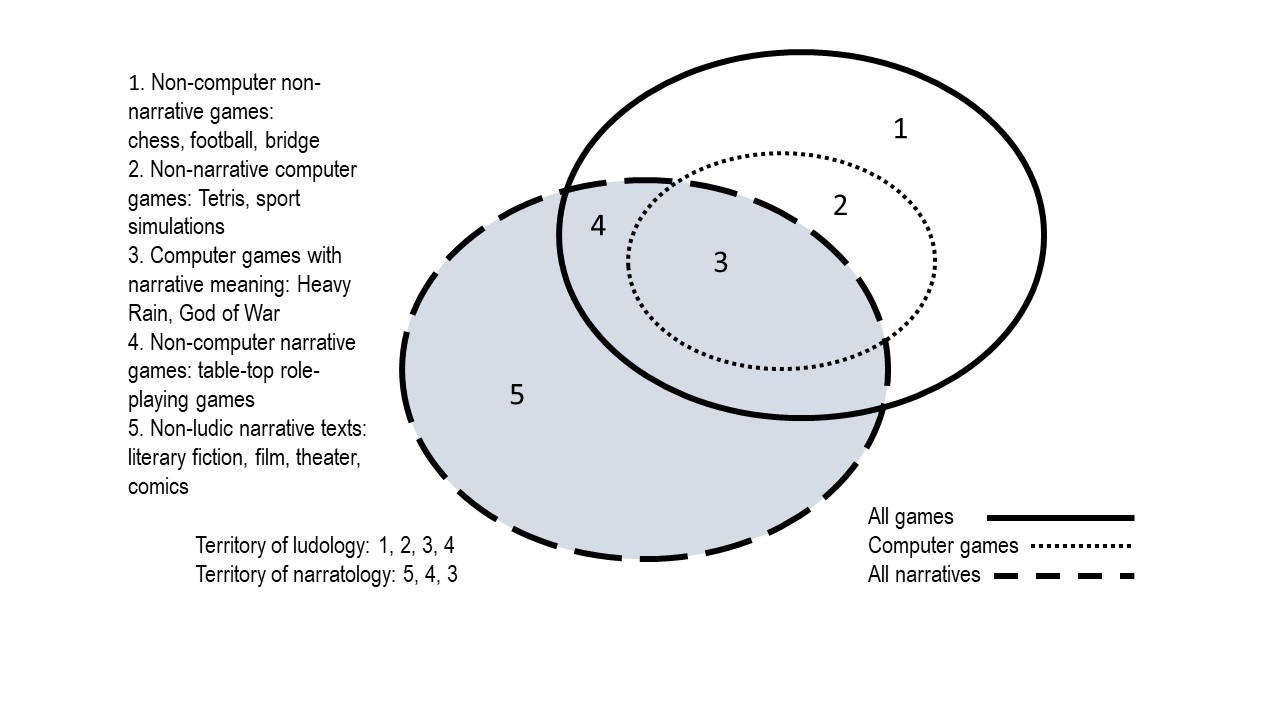
Fig.1 The relation between ludology and narratology.
The reconciliation of game studies and narratology was facilitated by a development that took place at the turn of the millennium and that David Herman called "post-classical narratology." This development extended the corpus of narratology to include non-literary and non-fictional language-based genres (news, historiogaphy, conversational storytelling), as well as image-based media such as film, drama, graphic novels, digital narratives and games. This meant giving up the definition of narrative as "somebody telling somebody else ([through language]{.mark}) that something happened" in favor of a more encompassing formula that locates narrativity in the representation formed in the mind of the recipient in response to a group of signs. (The exact nature of this mental representation is a matter of debate; for an attempt at a specification, see Ryan 2006.) Postclassical narratology opened games to narratological investigation, but this does not mean that game studies are a colony of narratology, since the set of all games intersects with the set of all stories, rather than being included in it.
An argument against the importance of narrative in games is that games derive their identity from their rules; the stories in which these rules are wrapped are, according to Eskelinen, just decoration, a way to lure players into the game that is quickly forgotten once the player gets caught in the fire of the action. Salen and Zimmerman have shown that the game Chutes and Ladders exist in many versions, but from a mathematical point of view it is the same game of adding or subtracting randomly chosen numbers until one of the players reaches a certain total regardless of the board decorations; the chutes could be snakes and the ladders could be escalators without impact on the rules. Similarly, for anti-narrativists, it does not matter whether computer games are presented as an attempt to save the earth from invading aliens or as battling Nazi armies, as long as you reach these goals by taking certain types of action determined by the rules. Children however will tell you that it is extremely important whether their board games feature ferocious animals or racing cars, Harry Potter or Superman. To acknowledge the importance of the narrative dimension of video games is to recognize that games engage not only the body – through physical skills – and the strategic mind but also the imagination. It is their narrative content that allows games to have meaning.
Another anti-narrative argument has been advanced by Ian Bogost in an article – or rather, a manifesto – titled: "Videogames Are Better Without Stories." Bogost claims that "the best interactive stories are still worse than even middling books and films." Most game stories would not stand on their own if they were told through books or films. Commenting on the game What Remain of Edith Finch (Anapurna Interactive, 2017), a so-called walking simulator whose gameplay consists of moving around a visually enticing 3D world and looking at objects that reveal a much more sophisticated narrative than the story told by your average first-person shooter, Bogost asks: "Why does this story need to be told in a video game?", implying that it should be a novel or a film. His point is that for a game to tell a really engrossing story, it has to reduce the range of possible user actions, as do walking simulators, and therefore sacrifices gameplay to narrativity. It may be true that game stories may never achieve the artistic level and variety of novels, drama or film, because the need to make room for player actions places significant constraints on their design. But just as the stories of film, theater, comics or literature are adapted to their medium, so are the stories of games: they are meant to motivate playing and not to be extracted from the gaming environment. And even if game stories considered in isolation have not reached the level of purely narrative interest of non-interactive stories, they still have much to gain by trying to realize their narrative potential. If games were better without stories, why would the game industry bother to spend money hiring scriptwriters and well-known actors to voice the characters?
Though the vast majority of computer game present some degree of narrativity, the contribution of this narrative content to the game experience is highly variable. As Marc Marti has shown, its weakest form (or endo-narrativity) occurs in games like Super Mario Brothers (Shigeru Miyamoto / Nintendo Entertainment System, 1985), which rely on a simplistic plot (rescue the princess) created without the help of scriptwriters. Players "try to perform the best they can actions like jumping, running, catching, shooting, hitting, accelerating, and braking without necessarily taking into consideration their integration in a narrative" (2014, p. 27; my translation.) A fully developed narrativity is found in games like Heavy Rain (Sony Computer Entertainment, 2010) or God of War (Sony Interactive Entertainment, 2016). These games use both live action and cut scenes to implement a complete, pre-written storyline, often with multiple endings, that players discover as they progress in the game. The alternance of playable scenes and narrative cut scenes means that attention is divided between gameplay and story. One would expect that by reducing gameplay to a bare minimum, walking simulators would place the greatest emphasis on the pre-scripted story, though this is not necessarily the case: the pleasure of exploring a beautiful world may take precedence over the story hidden in the environment. This is why these games are sometimes called "environmental games."{.mark} While in what Jesper Juul (2005) has called "games of progression" the narrative script affects the macro-level, multiplayer games like World of Warcraft (Blizzard Entertainment, 2004) rely on micro-narratives represented by individual quests that players discover as they wander through the world. And finally, simulation games like The Sims (Maxis 2014) do not rely on a pre-scripted story (or only partially so), but on a system of existents endowed with variable possibilities of action. Stories emerge dynamically out of the game, as the player activates these affordances.
A feature that distinguishes the narrativity of games from that of other media is that, in addition to the distinction between the scripted story and the discourse that presents it, there is an additional level of narrativity, namely the story constituted by the actions of the player, which may be recorded by a game camera and shared with other gamers. While games may (or may not) specify the order in which players must pass certain checkpoints to progress in the game, every player's performance will be different: some will pass the tests at first try, some will die and will need to start again, some will quit in frustration. Just as we write the story of our life through our actions, so do game players with the life of their avatar.
Narratological approaches to games
All the features mentioned above make narratology theoretically relevant to game studies. On a more specific level, what can narratology contribute to ludology? Here we must distinguish narratology as the use of a certain set of tools and concepts from narratology as an approach to games and other media sensitive to their narrative content. This second conception regards narratology as a work in progress; rather than applying pre-set categories top-down to games, it asks how our understanding of games can be enriched by the study of their narrative dimension.
This is not to say that standard narratological concepts cannot be useful. These concepts differ in their range of applicability: some describe universal properties of narrative, such as character, action, setting, causality, time, space and more generally storyworld, and they will be automatically relevant to games. Since all stories involve time, disruptions of chronological order can be observed in all narrative media, including games, even though they are less frequent in games than in film or literature. Some concepts, though not belonging to narrative universals, have a strong transmedial relevance; one example is the concept of narrator, which is optional in games, film and comics, rare in theater (it occurs in the chorus of Greek tragedy), but arguably mandatory in literary narrative, though this is contested by recent narrator-optional theories (Patron 2020). When narrators are used in games, they can be described through Genette's categories of intra, extra, homo- and heterodiegetic, and like literary narrators, they can be either reliable or unreliable. The distinction between first-person and third person point of view, though originally conceived for literature, is as productive for games as it is for language-based texts. Some properties may be distinctive in one medium, but optional in other media. For instance, all games rely on an ergodic structure, i.e., a structure involving "non-trivial effort to traverse the text" (Aarseth 1997, p. 1), but only some language-based narratives are ergodic: those that build choice into their design. Some narratological concepts are highly medium-specific; for instance, the technique of free indirect discourse to represent character speech and thought presupposes language-based narrative. Example of game-specific concept are those of avatar, non-playing characters (NPCs), point of action (Neitzel 2024, 619), and the contrast between inert and active objects. Aarseth's classification of player function into explorative, configurative, interpretative and textonic, as well as his distinction between personal and impersonal manifestation (i.e., with or without an avatar) does for player involvement what Genette's distinction between homo, hetero, extra and intradiegetic does for narrators. Another example of game-specific concepts is Daniel Punday's (2017, 93) important distinction between game space (the area where the player takes action) and orienting space (the tool-bars, menus and maps through which players equip themselves for action or that help them plan their next move). There are also concepts popular with narratologists that apply to games as well as to other media, but do not presuppose narrativity. One of them is metalepsis, the transgression of ontological boundaries. Metalepsis occurs in literature, film, games (for instance in Metal Gear Solid (Konami Entertainment, 1998) where a game character pretends to infect the user's computer with a virus), but also in non-narrative paintings by Magritte and Escher. A narratological approach to games can both expand the toolbox of narratology by developing game-specific concepts, and increase the range of already described concepts by demonstrating their transmedial relevance to games.
If ergodic structure is constitutive of games, an important part of game narratology will be a typology of its possible forms (Ryan 2006). This structure can be linear, as in what Juul calls games of progression; tree-based, most in Choose Your Own Adventure texts but possible in computer games; network-based, when the underlying structure presents loops that allow players to return to already visited points; or flowchart-based, when players progress linearly but can reach the next checkpoint through several distinct paths. Multiple tails can be added to every configuration to express the possibility of many different endings.
The discussion of the structural types of narrative that offer opportunities for player action is an integral part of game narratology. Henry Jenkins has distinguished four types of narrative designs in games: (1) Evoked narratives are stories adapted from another medium, such as American McGee's Alice (Rogue Entertainment 2000) or Star-Wars-based games. The original story is usually too complex to be fully implemented in the games, but it is suggested through visual elements, character names, and some basic features of the original, for instance using light sabers as weapons in a Star Wars game. (2) Enacted narratives (a questionable label since enactment also occurs in the other categories) are games that present an episodic structure, modelled after Joseph Campbell's Hero's Journey. Identifying with an avatar that represents the hero, the player travels across game space, and meets various challenges in order to fulfill a quest. The episodic structure makes it possible to add ever new levels to the game. (3) Embedded narratives are stories hidden in the gameworld that players discover by exploring the environment, looking at objects and interviewing non-playing characters. Examples of this structure are detective games, walking simulators and (in part) the side quests of MMORPGs]{.mark}, though these quests are also enacted narratives{.mark} . (4) Emergent narratives, represented by The Sims and other simulation games, "are not prestructured or pre-programmed" (2004, 128), they take shape during gameplay. Whether Jenkins' lists stand the test of time or needs to be revised, it is very close in spirit to the typological ambition of classical narratology.
The influence of recent trends in narratology (cf. the work of Suzanne Keene [2007] and James Phelan [2005]) on game studies should lead to greater attention to emotions, empathy, and ethical dilemmas (Sicart 2013). A game could make the player feel guilty of sacrificing innocent civilians in order to gain advantage in a war game; non-playing characters could be more than enemies to be eliminated or helpers who offers useful items: as the sophistication of game narratives increases, NPCs can become complex, three-dimensional persons who inspire emotions such as pity, contempt, respect, trust or suspicion.
Another promising area for narratological investigation is how games deal with the manifestations of certain features important to narrative that are easily represented in literary narrative, but more problematic in other media. The work of Jan-Noël Thon on transmedial narratology (2016) is representative of this possibility. He asks how the subjective perspective of characters, such as dreams, hallucinations, and more generally private thoughts – a common occurrence in literary narrative – can be represented in games. This comparative line of inquiry can also be pursued with other features, such as time and space.
In order to present elaborate narratives, games often rely on cinematic cut scenes. This could lead to the conclusion that games alternate between narrative, non-interactive elements, and non-narrative, interactive ones, and that game narratology is strictly concerned with the former. Wikipedia entries for games support this view by treating plot and gameplay under different headings, suggesting their independence from each other. In this reasoning, game narratology would be a province of film studies, since cut scenes use the expressive resources of film. But as Arsenault observes, this is a simplistic view, because the player's actions may determine which cut scenes are shown and when. In a game with multiple endings, for instance, the cut scene that represents a specific ending may not depend on deliberate choices, but on actions taken much earlier in the game and whose effect cannot be predicted by the player. Another reason for rejecting the restriction of narration to non-interactive element is the feature I have mentioned above: the almost instantaneous showing of the player's actions by the system, which functions as the narration of the player's life in the game. One of the most challenging tasks that face game narratology is to show how narrative meaning emerges out of gameplay, and how gameplay determines what stories can be told in the medium of games.
Conclusion
The borders of narratology are fuzzy. It started as a taxonomic discipline concerned with structure (of discourse or of story), but now it embraces philosophical reflection about the nature of narrative, its evolutionary development, its distinctiveness as a way of thinking, and its role in creating a sense of identity. It has also grown feminist, post-colonialist and ecological branches that are more interpretative than taxonomical. Narratology is now a much bigger tent than in its classical phase and it is hard to tell what work belongs in it. We do not think of Henry Jenkins or Espen Aarseth as narratologists; yet Jenkins' typology of game designs, or Aarseth's list of types of player involvement are in spirit as narratological as Genette's foundational work---they just concern another medium. Just as Monsieur Jourdain in Molière's play Le Bourgeois Gentilhomme spoke prose without being aware of it, many game scholars perform narratological work without thinking of themselves as narratologists. Any approach to games concerned with their stories as a level of meaning that transcends purely physical player actions, but that depends nevertheless on the performance of these actions should be considered narratological.
Bibliography
Aarseth, E. (1997). Cybertext : Perspectives on Ergodic Literature. Johns Hopkins University Press.
Alexey Pajitnov (1984). Tetris. Elektronica 60 / Multiple platforms.
Arsenault, D. (2006). Jeux et enjeux du jeu vidéoludique : la narration dans le jeu vidéo. University of Montreal, MA thesis.
Barthes, R. (1966). "An Introduction to the Study of Narrative." New Literary History 6, 237-72.
Blizzard Entertainment (2004). World of Warcraft. Blizzard Entertainment/ Online
Bogost, I.(2017). "Videogames are Better Without Stories," The Atlantic (2017). https://www.theatlantic.com/technology/archive/2017/04/video-games-stories/524148/
Bordwell, D. (1985). Narration in the Fiction Film. Methuen.
Bremond, C. 1(973). Logique du récit. Seuil.
Chatman, S. (1978). Story and Discourse: Narrative Structure in Fiction and Film. Cornell University Press.
Eskelinen, M. (2012). Cybertext Poetics: The Critical Landscape of New Media Literary Theory. Continuum, 2012.
Gaudreault, A. and F. Jost. (2017). Le Récit cinématographique: Films et séries télévisées. Armand Colin.
Genette, G. (1980). Narrative Discourse : An Essay in Method. Translated by J. Lewin. Cornell University Press.
Giant Sparrow (2017). What Remains of Edith Finch ? Anapurna Interactive / Microsoft Windows
Herman, D. "Introduction: Narratologies." In D. Herman (Ed.), Narratolgies : New Perspectives on Narrative Analysis (pp. 1-30). Ohio State University Press.
Infocom (1977). Zork. Personal Software, Infocom, Activision / Apple 2
Jenkins, H. (2004). "Game Design as Narrative Architecture." In N. Wardrip-Fruin and P. Harrigan (Eds.), First Person: New Media as Story, Performance and Game (pp.118-30). MIT University Press.
Juul, J. (2001). "Games Telling Stories: A Brief Note on Games and Narrative.
Juul, J. (2005). Half-Real : Video Games Between real Rules and Fictional Worlds. MIT University Press.
Keen, Suzanne (2007). Empathy and the Novel. Oxford University Press.
Konami Entertainment Japan (1998). Metal Gear Solid. Konami Entertainment/ Microsoft Windows, Playstation.
Marti, M. (2014) "La narrativité vidéoludique : une question narratologique." Cahiers de Narratologie. https:// journals.openedition.org/narratologie/7009
Maxis (2014 ). The Sims. Electonic Arts / Microsoft Windows.
[Murray, Janet (2005). "The Last Word on Ludology v. Narratology." https://inventingthemedium.com/2013/06/28’the-last-word-on-ludology-v-narratology-2005/]{.mark}
Namco (1980). PacMan. Namco / Arcade
Neitzel, B. (2014). "Narrativity of Computer Games." In P. Hühn, J.- C. Meister, J. Pier and W. Schmid (Eds.), Handbook of Narratology, vol 2 (pp.608-622). De Gruyter.
Nintendo (1985). Super Mario Bros. Shigeru Miyamoto / Nintendo Entertainment System.
Patron, S., ed. (2020) Optional Narrator Theory: Principles, Perspectives, Proposals. University of Nebraska Press.
Phelan, James. (2005). Living to Tell About it: A Rhetoric and Ethics of Character Narration. Cornell University Press.
Phelan, J. and P. Rabinowitz (2012). "Authors, Narrators, Narration." In D. Herman, J. Phelan, P. Rabinowitz, B. Richardson and R. Warhol (Eds.), Narrative Theory: Core Concepts and Critical Debates (pp. 29-38). Ohio State University Press.
Prince, G. (1987). Dictionary of Narratology. University of Nebraska Press.
Propp, V. (1968 [1928]). Morphology of the Folktale. University of Indiana Press.
Punday, D. (2019). Playing at Narratology: Digital Media as Narrative Theory. Ohio State University Press.
Quantic Dream (2010). Heavy Rain. Sony Computer Entertainment, Quantic Dream / Playstation, Microsoft Windows.
Remedy Entertainment (2001). Max Payne. Gathering of Developers, Rockstar Games/ Microsoft Windows, Playstation
Rogue Entertainment (2000). American McGee's Alice. Electronic Arts /Microsoft Windows.
Ryan, M.-L. (2006). Avatars of Story. University of Minnesota Press.
Salen, K. and E. Zimmerman (2003). Rules of Play: Game Design Fundamentals. MIT University Press.
Santa Monica Studios, Ready at Dawn, Javagrounds (2016). God of War. Sony Interactive Entertainment / Microsoft Windows, Playstation.
Sicart. Miguel (2013). Beyond Choice: The Design of Ethical Gameplay. MIT University Press.
Thon, J.-N. (2016). Transmedial Narratology and Contemporary Media Culture. University of Nebraska Press.
- Todorov, T. (1969). Grammaire du Décameron. Mouton.
Citation Information
Ryan, M.-L. (2023). Narratology. In Grabarczyk, P. (ed.), Encyclopedia of Ludic Terms (Spring 2022 Edition). URL: https://eolt.org/articles/narratology/
Copyright
©2026 Encyclopedia of Ludic Terms (EoLT) Copyright for articles published in this encyclopedia is retained by the EoLT, except for the right to republish in printed paper publications, which belongs to the authors, but with first publication rights granted to the encyclopedia. By virtue of their appearance in this open-access encyclopedia, articles are free to use, with proper attribution, in educational and other non-commercial settings.